Introduction · Altiplano: Bolivia, Peru, northern Chile
Aymara
The people of the high plateau around Lake Titicaca, more than two million people across Bolivia, Peru and northern Chile, farming and herding some of the highest worked land on Earth.
Preliminary researchHow to read this
Aymara country is the altiplano: the high plain around Lake Titicaca where Bolivia and Peru meet, reaching south into Chile's far north. It is a landscape of potato and quinoa fields and llama and alpaca herds, worked at altitudes where little else grows, and of dense market networks that bind countryside to city. El Alto, on the rim above La Paz, has grown into one of the largest majority-Indigenous cities in the Americas.
Aymara-speaking lords held the lake country for centuries between the fall of Tiwanaku and the Inca expansion, and the language survived Inca and Spanish rule alike. The colonial economy pulled Aymara labour into the silver mines of Potosí; the republics that followed taxed and dispossessed the communities they depended on, a history the communities themselves never stopped contesting.
In Bolivia, where 1.6 million people declared themselves Aymara in the 2012 census, the people are central to national life: the wiphala flies as a state symbol, the language is constitutionally official, and in 2005 the country elected its first Indigenous president, of Aymara origin. Peru's 2017 census counted 548,000 Aymara; in Chile, Aymara communities continue in the highlands and cities of the far north.
This is an introduction, the first layer. A full collection, like the Mapuche collection that opened this atlas, follows as research and review are completed for each people.
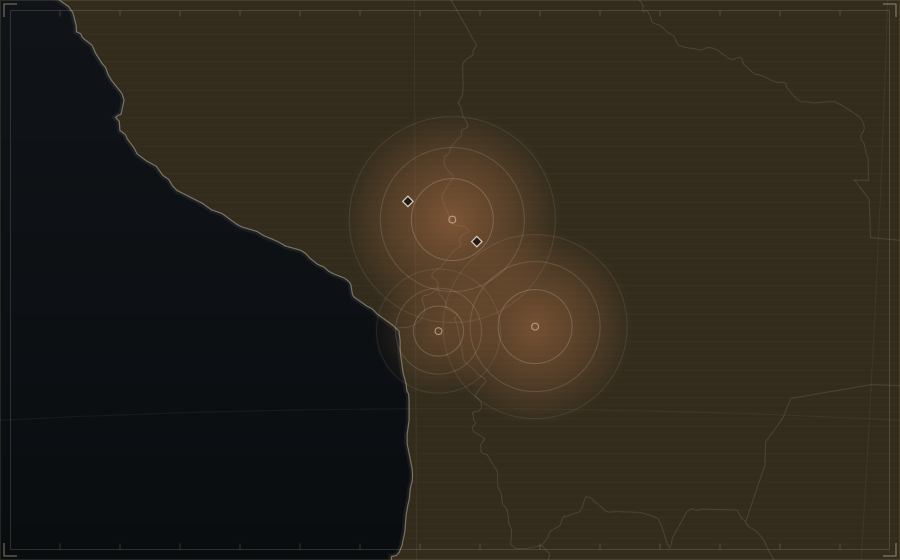
- Where
- The altiplano: Bolivia, southern Peru, northern Chile
- Language
- Aymara: constitutionally official in Bolivia, and in Peru where it predominates
- People
- 1.60 million self-identified in Bolivia (2012 census) · 548,292 in Peru (2017 census)