Peoples of the Americas · First collection
Mapuche
People of the land · mapu, land · che, people
The Mapuche are an Indigenous people of south-central Chile and southwestern Argentina. Their country, Wallmapu, reaches from the Pacific across the Andes into Patagonia. They stopped the Inca's southward advance, held colonial Spain to treaty for two centuries, and remain, after military occupation and land loss in the 19th century, the largest Indigenous people in Chile, with communities, language and politics very much alive.
Featured historical figure
Leftrarucommonly known as Lautaro
War leader of the rising of 1553–1557 · c. 1534–1557
No authenticated likeness of Leftraru (Lautaro) exists, so no face is shown, here or anywhere on this platform. In its place stands his documented world: the dress, armour and weapons of his own century, mark by mark, each traceable to a source.
Peoples of the Americas · First collection
Mapuche
People of the land · mapu, land · che, people
The Mapuche are an Indigenous people of south-central Chile and southwestern Argentina. Their country, Wallmapu, reaches from the Pacific across the Andes into Patagonia. They stopped the Inca's southward advance, held colonial Spain to treaty for two centuries, and remain, after military occupation and land loss in the 19th century, the largest Indigenous people in Chile, with communities, language and politics very much alive.
Featured historical figure
Leftrarucommonly known as Lautaro
War leader of the rising of 1553–1557 · c. 1534–1557
Scroll, identity, objects, land, language, now
His material world
The 1550s, as documented
What Leftraru's century actually wore and carried comes from the chronicles of his own war: wool mantles and short shirts as Bibar describes them, hardened-leather armour, copper-tipped pikes, and heads shorn for war. The famous silver belongs three centuries later, so it isn't here.
Each of these marks is checked against the written record, claim by claim; the familiar long-haired, headbanded image did not survive that check. Positions are approximate.
- Shorn for war: wartime hair practice
- Wool mantle: 16th-century dress
- Leather armour: hardened hide
- Waiki: lance
Land
Wallmapu, the Mapuche country
From the Pacific across the Andes into Patagonia: Ngülumapu to the west, Puelmapu to the east. Two centuries of treaty- recognised autonomy ended with the military occupations of the late 19th century, the land question has never closed.
About Wallmapu →Beyond one life
Mapudungun is spoken now
Mapuche history does not begin or end with Leftraru. Nearly five centuries after his rising, the speech of the land is taught in communities and universities, written in several alphabets, and carried into new media by a generation set on keeping it alive.
Continue below, history, society and contemporary life ↓
No authenticated likeness of Leftraru (Lautaro) exists, so no face is shown, here or anywhere on this platform. In its place stands his documented world: the dress, armour and weapons of his own century, mark by mark, each traceable to a source.
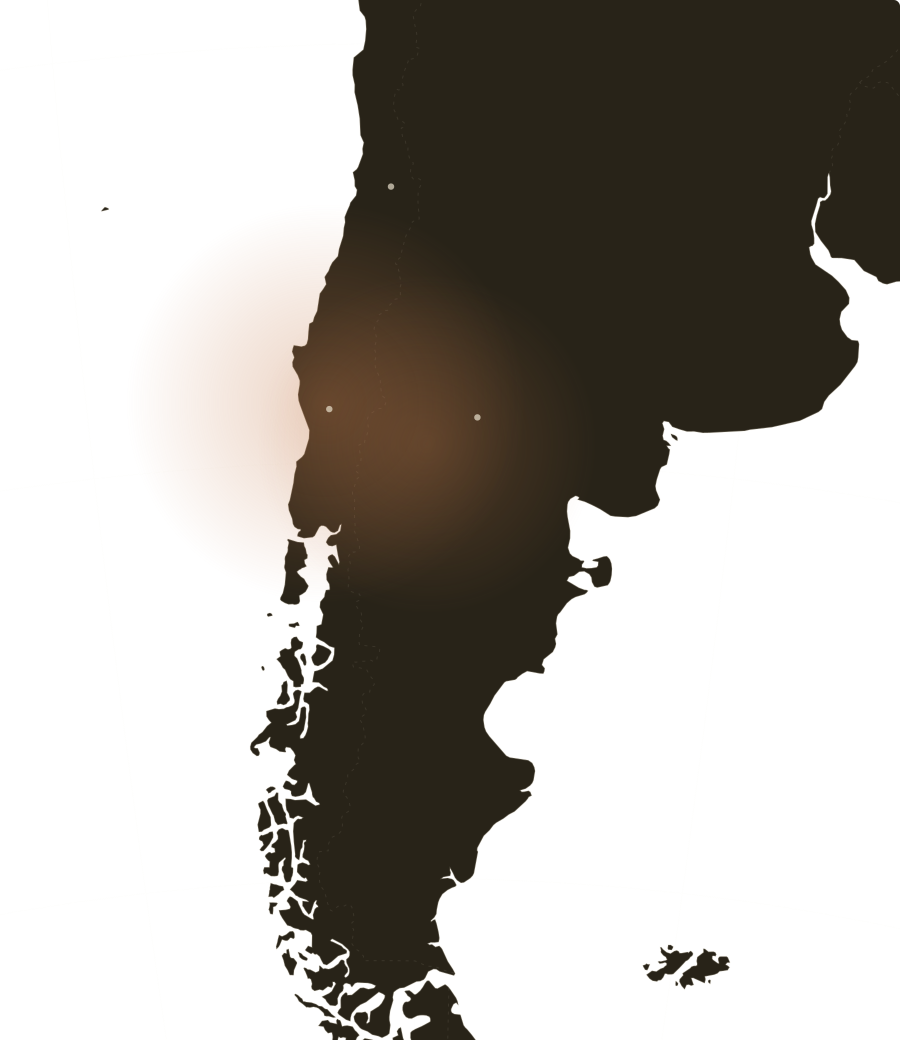 Ngülumapuwest of the AndesPuelmapueast of the AndesSantiagoTemucoNeuquén
Mapudungun
Mari mari
Audio pending, native-speaker recordings only, never synthetic voices
At a glance
The Mapuche today
An Indigenous people of south-central Chile and southwestern Argentina, the largest Indigenous people in Chile today, with a living language, Mapudungun, and an unbroken political and cultural history.
Preliminary researchHow to read this
Self-identified population
≈ 1.75 million (Chile) · ≈ 205,000 (Argentina)
Census self-identification: Chile 2017, Argentina 2010.
DocumentedLanguage
Mapudungun
“Speech of the land.” Speaker estimates vary widely by method.
DocumentedTerritory
Wallmapu
Ngülumapu west of the Andes; Puelmapu to the east. Extents are historical, layered and partly contested, this site draws presence, not borders.
ApproximateIdentity
Named from the land itself
Che means person; what stands before it is geography. The Mapuche name themselves, and their inner diversity, from the places they stand.
Lafkenche
people of the sea
The coast, from the Biobío south through Los Ríos
Pewenche
people of the pewen
The high cordillera of the Biobío and eastward
Wenteche
people of the valleys above
The central valleys of Cautín
Nagche
people of the lowlands
The western foothills of Malleco
Williche
people of the south
From Los Ríos through Osorno to Chiloé
Puelche
people of the east
Puelmapu, the plains east of the Andes; historically the name has covered varied peoples
Pikunche
people of the north
Historically, the lands toward the Itata and beyond, a name now mostly of the past
The pattern carries the worldview: identity is spoken from the land itself, lafken (sea), pewen (the araucaria pine), nag (lowland), willi (south), joined to che, person. These identities are relational and alive, not administrative boxes: they name where one stands, they have shifted with history, and they are actively invoked today, as when coastal communities organised as Identidad Territorial Lafkenche to shape Chile's coastal-space law.
Commonly described identities with approximate geographies, relational, historical and living, not an official register.
See the geography →History
Five centuries of holding ground
Anchor events, each labelled with its evidential weight. History written from sources, including where the sources argue.
Deep time
Origins in the south Approximate
Archaeology traces continuous development in south-central Chile through the pottery traditions archaeologists call Pitrén (from around the 2nd century CE) and El Vergel (from around 1000 CE), horticulture, ceramics and settled life long before any written record. Scholars continue to debate the details of origins and early chronology.
15th century
The Inca frontier Contested
Colonial-era chronicles record that Inca expansion southward was stopped by armed resistance, with the frontier commonly placed near the Maule and Itata rivers. The accounts were written generations later and their details are debated.
1541–1641
Invasion and resistance Documented
Spanish colonisation from 1541 met sustained resistance in the long conflict remembered as the Arauco War. After the rising that began at Curalaba in 1598, Spanish settlements south of the Biobío River were abandoned or destroyed.
1641
The Parliament of Quillín Documented
A treaty concluded at Quillín recognised effective Mapuche autonomy south of the Biobío, an arrangement rare in colonial Spanish America, renewed through a long series of parlamentos, Negrete among the great later gatherings.
1825
Treating with the republic Documented
The young Chilean republic treated too: the Parliament of Tapihue reaffirmed the Biobío frontier and Mapuche self-rule beyond it. Within two generations the same state would choose conquest instead.
1861–1885
Occupation and dispossession Documented
The Chilean state's occupation of Araucanía (1861–1883) and Argentina's military campaigns in Patagonia (from 1878) ended Mapuche independence. Between 1884 and 1929, Chile's radicación confined communities to reducciones: some 2,900–3,100 títulos de merced allotted roughly 510,000–526,000 hectares to 82,629 people, an average near six hectares a person, a small fraction of the former territory.
20th century
Reorganisation Documented
Laws dividing community lands, rural poverty and migration carried much of the people to the cities. Across the century Mapuche organisations pressed for land, recognition and rights, in courts, congresses and the street, through cycles of reform, dictatorship and return to democracy.
1990s
Recognition, incomplete Documented
Chile's 1993 Indigenous Law recognised the Mapuche among the country's pueblos originarios and created CONADI. Land restitution and political recognition remained, and remain, contested in both Chile and Argentina.
2019–2022
The constitutional moment Documented
When Chile elected a convention to write a new constitution, it chose Elisa Loncón, a Mapuche linguist, as the body's first president in July 2021. The draft charter, which proposed a plurinational state, was rejected in the September 2022 plebiscite. The questions it carried remain open.
Land and geography
Wallmapu, the Mapuche country, spans the south-central valleys, coast and mountains of Chile and the adjacent plains of Argentine Patagonia. Mapuche usage commonly distinguishes Ngülumapu, the lands west of the Andes, from Puelmapu, the lands to the east.
The modern borders of Chile and Argentina cross this geography; they do not define it. Today, Mapuche communities are concentrated in La Araucanía and the neighbouring regions of Chile and in the Argentine provinces of Neuquén, Río Negro and Chubut, while a majority of Mapuche people live in cities, Santiago above all.
Community and society
The traditional unit of Mapuche social life is the lof, related families sharing territory under a lonko, the community's head, with the werken carrying its word outward as spokesperson. Machi, ritual specialists and healers, hold central roles in ceremony and traditional medicine; large communal ceremonies such as the ngillatun gather communities for prayer and thanksgiving, and az mapu names the customary norms of living rightly with land and people.
Not all of social life is solemn: palin, the fast field game played with curved sticks, remains a living practice that binds communities together, and the year still turns at We Tripantu, the new year of the June solstice.
This section stays deliberately short. Mapuche social and ceremonial life is a living system that deserves better than a summary compiled from outside sources, it will be expanded with Mapuche reviewers.
Knowledge and worldview
Mapuche knowledge, of land, medicine, weather and right relationship, is carried in Mapudungun and in practice. We have chosen not to summarise it from secondary literature alone: it will be written with Mapuche contributors and reviewers, or not at all.
Material culture
Weaving on the witral, the vertical loom, is an old and continuing art practised principally by women; textiles carry pattern languages that signal identity and standing, and their meanings belong with the weavers, we document forms, not decodings. The documented women's ensemble of the 19th century joins the küpam, a great black wrapped cloth pinned at the shoulder with a silver tüpu, the bordered ükülla shawl, and the woven trariwe sash.
Mapuche silverwork, rütran, flowered from the 18th century, when silver coin acquired in trade was reworked by rütrafe, specialist silversmiths, into the forms museum collections now document: trarilonko head ornaments hung with coins, chaway earrings, the trapelakucha pectoral of linked plates, tüpu pins, kilkai necklaces. Most surviving pieces date to the ethnographic period, roughly 1880–1910, and the craft lives, with contemporary rütrafe working and teaching today.
Wood, clay and stone carry their own traditions, from everyday ware to the monumental chemamüll, carved wooden figures raised over graves.
Food
Mapuche cuisine draws on the crops, coasts and forests of the south. Its signature seasoning, merkén, cacho de cabra chilli dried in the sun, smoked over the household fire, ground with toasted coriander seed and salt, now reaches kitchens far beyond Wallmapu. In the cordillera, the piñones of the pewen (the monkey-puzzle tree) anchor whole foodways; the Pewenche carry the tree in their name.
Contemporary life
The present tense
Not an afterthought at the bottom of a historical page: Mapuche life now, urban and rural, political and literary, spoken and sung.
A largely urban nation
Most Mapuche today live in cities, Santiago, Temuco, Concepción, Neuquén, Bariloche, while rural communities sustain territorial and ceremonial life across the south. Urban Mapuche identity is its own living culture, not a diluted one: the poet David Aniñir coined mapurbe for it, and a generation of writers, musicians and organisers has built on the word.
Politics and the unfinished question
In July 2021, Chile's Constitutional Convention elected the Mapuche linguist Elisa Loncón as its first president, a moment watched around the world. The draft constitution's proposal of a plurinational state was rejected in the 2022 plebiscite, but the questions it raised, land restitution, recognition, political representation, remain the live centre of Mapuche politics in both Chile and Argentina. This site links to reporting rather than summarising a moving situation.
Letters and art
Mapuche writing is central to contemporary Latin American literature: Elicura Chihuailaf became the first Mapuche writer awarded Chile's National Prize for Literature in 2020; Leonel Lienlaf and Graciela Huinao carried Mapudungun and Williche memory into poetry; David Aniñir's Mapurbe named the urban experience; the journalist Pedro Cayuqueo's histories became national bestsellers. Silverwork, weaving and music continue in contemporary hands, including the rütrafe and weavers now co-writing museum catalogues about their own tradition.
The language, coming forward
Mapudungun revitalisation runs through community programmes, university courses, new media and public life, from the commune of Galvarino making the language co-official in 2013, to teaching projects like Kimeltuwe reaching mass audiences online, to the language sounding from a national podium in 2021. Its future is being argued for, daily, by people teaching it to children.