Introduction · Mesoamerica: Guatemala, Mexico, Belize, Honduras
Maya peoples
“Maya” covers many distinct peoples, K'iche', Q'eqchi', Kaqchikel, Mam, Yucatec, Tsotsil, Tseltal and more, each with its own language and territory.
Not one people but many, speakers of some thirty related languages across Guatemala, southern Mexico, Belize and Honduras; heirs of one of the world's great civilisations, and emphatically present tense.
Preliminary researchHow to read this
The Maya world spans the highlands and lowlands from Chiapas and the Yucatán peninsula through Guatemala into Belize and western Honduras. In Guatemala, Maya peoples are close to half the country, about 42% of the population identified as Maya in the 2018 census, with K'iche' the largest of the country's Maya peoples at over a million and a half people.
The classical Maya cities, with their mathematics, astronomy and the hemisphere's most complete pre-contact writing system, were transformed long before Europeans arrived, not ended: independent Maya polities met the Spanish invasion centuries later, and Maya communities carried their languages and lands through colonial rule, plantation economies, and the Guatemalan armed conflict of 1960–1996, whose violence fell overwhelmingly on Maya communities.
Today Yucatec Maya counts 774,755 speakers in Mexico's 2020 census, and Mayan languages are taught, written and broadcast on both sides of the border. Maya writers and weavers' cooperatives, language academies, and the Nobel laureate Rigoberta Menchú Tum have made this one of the most visible Indigenous presents in the hemisphere.
This is an introduction, the first layer. A full collection, like the Mapuche collection that opened this atlas, follows as research and review are completed for each people.
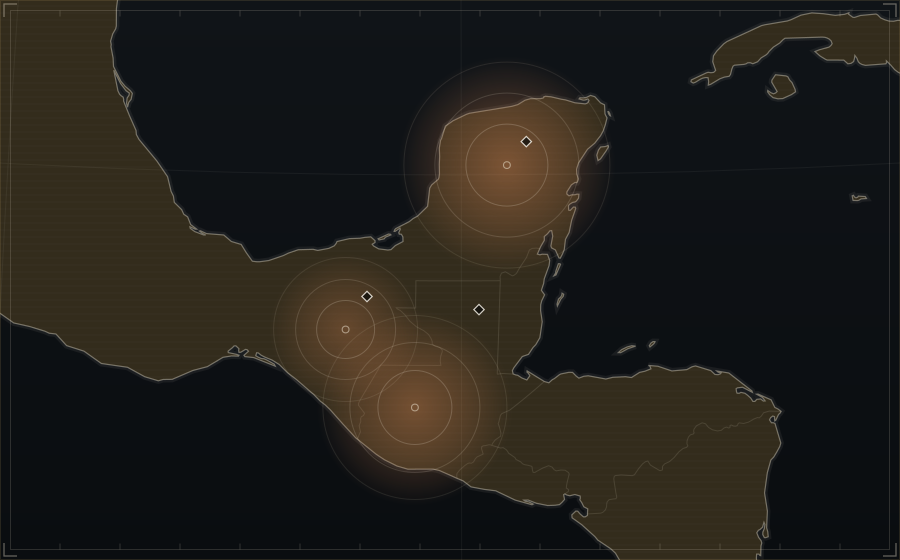
- Where
- Guatemala, southern Mexico, Belize, western Honduras
- Languages
- About thirty Mayan languages: K'iche' and Yucatec Maya the largest
- People
- ≈42% of Guatemala: over six million people (2018 census) · 774,755 Yucatec Maya speakers in Mexico (2020 census)